en
In 2019, the Company generated electricity and thermal energy, provided provide tertiary and secondary active power reserve service in Elektrėnai complex, secondary active power reserve service in Kruonis PSHP and other system services.
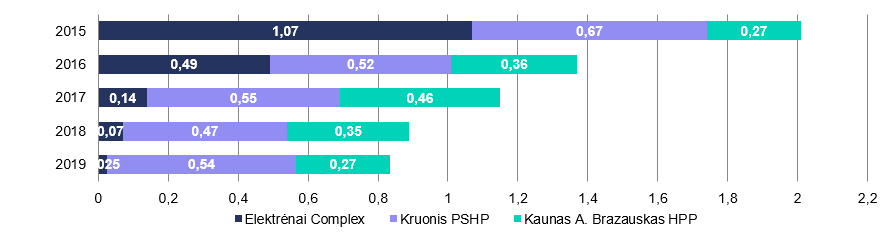
The Company has permissions of unlimited duration to produce electricity. The amount of electricity generated in the Company’s power plants during January–December 2019 differs insignificantly from that of January–December 2018 (see figure below). In total, 0.83 TWh of electricity generated in the Company’s power plants was sold in the power exchange in 2019, 0.88 TWh in 2018 (less 6%).
In Kaunas HPP, the generation volumes were affected by the drought which started already in spring of 2019. The snow has been scarce, melted gradually and did not cause bigger floods. During summer months, the situation deteriorated – a hydrological drought has been announced in Lithuania. The drought period (with a flow rate of 112 m3/s for at least three days) lasted from July to September, with an average flow rate of about 107 m3/s, during the same period in 2018 - about 142 m3/s. Due to lower water flow rate (average water flow rate was app. 23% lower compared to 2018) in 2019, Kaunas HPP generated and sold almost 22% less electricity than in 2018 (0.35 TWh in 2018 and 0.27 TWh in 2019).
Efficient use of Kruonis PSHP potential for stabilizing electricity prices in the market (due to increased difference between daily peak and night-time electricity prices) resulted in 14.1% higher sales of the electricity produced in Kruonis PSHP in 2019 – 0.54 TWh (0.47 TWh in 2018).
Q1 and Q4 of 2019, generation in Kruonis PSHP was lower than in 2018. Decrease in production in Q1 was influenced by a 9% decline in the ratio between day and night prices, which was about 17–18% higher in the second and third quarters and about 2% lower in the last quarter compared to the same period in 2018. The price changes may have been influenced by a change in the balance of imports, as described above. Lower production volumes in the first quarter could also be influenced by about 52% higher wind power production in Lithuania, which in the second and third quarters were similar to last year, and about 35% higher in the fourth quarter. July and August in Kruonis PSHP were peak months with three times as much electricity generated in July and about 87% more in August – more than in 2018. The increase in production was also influenced by the above-mentioned decrease in domestic production in Estonia.
During 2019, the Company sold 0.055 TWh and purchased 0.023 TWh of regulation electricity (the service necessary to balance the surplus/shortage of electricity in the system). The respective amounts for January–December 2018 had been 0.075 TWh and 0.035 TWh.
Another ancillary service provided by Kruonis PSHP is the secondary power reserve, i.e. the power of facilities or hydro-units maintained by the producer activated in 15 minutes. During January–December 2019, 0.014 TWh of electricity has been produced during the activations of this service (0.015 TWh in January–December 2018). The TSO usually activates the secondary power reserve (for which two units (400 MW) of Kruonis PSHP are assigned in 2019) when there is a need to compensate a sudden drop in electricity transmitted to Lithuania. During January–December 2019, the Company sold around 3.50 TWh of the secondary power reserve – the same amount as during January–December 2018.
Generation volumes in Elektrėnai Complex remained limited during 2019 (0.025 TWh in 2019 and 0.067 TWh in 2018). In 2019, the tertiary active power reserve in the scope of 260 MW was ensured by the most effective unit of Elektrėnai Complex – the combined cycle unit (CCU). The tertiary active power reserve is the power of power-generating sources maintained by the producer, which is activated within 12 hours. This reserve is activated by the TSO. CCU was constantly ready to produce electricity and contribute to the overall security of the energy system. The production of the combined cycle unit on a commercial basis is only available with the residual power (the power remaining from designated for the service of tertiary reserve).
The ability of the unit to operate at residual power is highly dependent on the air temperature. If the weather warms up, the unit cannot operate at the residual power. During 2019, the Company sold around 2.29 TWh of the tertiary power reserve – slightly more than during the same period in 2018 (2.28 TWh).
Electricity produced in the Company's controlled power plants and traded (TWh)